
Every year, as spring gives way to summer, we experience more than just hot weather in the UAE. Multiple atmospheric factors contribute to a climatic shift. Higher surface temperatures result in warmer air and increased humidity levels, whereas the change in wind patterns bring intense dust storms with them. This evolving ecosystem behaviour impacts the ambient air quality, often adversely.
Gaseous emissions resulting from rapidly growing urban development become more potent during summer. Rising temperatures accelerate atmospheric reactions, and an increase in the concentration of particulate matter due to shifting wind patterns contributes to the worsening of the air quality throughout the season.
In simpler terms, when we compare air quality in January to air quality in July, it’s clear that what we breathe in summer is much more hazardous to our health than winter air. This atmospheric change impacts the UAE and the wider GCC intensely as high temperatures, seasonal dust events, and increased humidity combine with the dense urban activity, transport emissions, and industrial output.

However, this is far from just a GCC problem. Globally, almost the entire population of the world breathes air that exceeds WHO guideline levels. Ambient and household air pollution result in millions of deaths each year, with nearly everyone exposed to levels that increase the risk of heart disease, stroke, chronic obstructive pulmonary disease, cancer, and pneumonia.1
Environmental changes due to seasonal shifts are clear signs that climate, air quality, and health should be planned and addressed holistically, not in silos, and not only when conditions become extreme enough to demand attention.
The hidden cost of warmer days
Rising heat alone increases heat stress, but it also drives a second, less visible risk: sunlight and heat together accelerate the reactions that form ground-level ozone, meaning concentrations often peak during the hottest, sunniest parts of the year rather than during winter months. In other words, the same conditions that make a hot day feel uncomfortable are often the same conditions quietly pushing pollutant levels higher.
Humidity compounds the problem further. As moisture in the air rises, the body’s ability to cool itself weakens, making heat feel more intense and harder to manage. Wind also creates a layer of unpredictability, where on some days it disperses pollutants and cleans the air and on others it mobilises dust and particulate matter, transporting them across cities and borders.
Ambient air (outdoor air pollution) contains potentially harmful pollutants emitted by industries, households, and vehicles. Of all these pollutants, fine particulate, most of which produced from fuel combustion from vehicles, power plants, industry, households, or biomass burning is reported to have the greatest effect on human health.2
Analysis of particulate matter (PM) concentrations over Abu Dhabi’s 19 air quality stations3 from 2020 showed that levels were elevated between June and August. Higher concentrations of PM10, PM2.5, and heavier air pollutants were found in stations closer to industrial areas, especially where cement and ceramic factories were situated. Subsequently, sub-urban areas impacted by heavy transportation for trading and material suppliers were shown to have the second highest concentration of pollutants. Nearby communities are therefore more prone to adverse health impacts than urban populations, where stricter regulations on transport and the 40% transition to renewable energy have contributed to comparatively better air quality levels.
More recent research4 looked at historical air quality data from 2015 to 2023 and provided a statistical breakdown for nitrogen dioxide, PM10, and PM2.5 across Abu Dhabi. Levels of PM10 and PM2.5 were shown to rise steadily from January, reaching their highest levels in July before falling.
Figure 2: Locations of Abu Dhabi’s 19 air quality stations
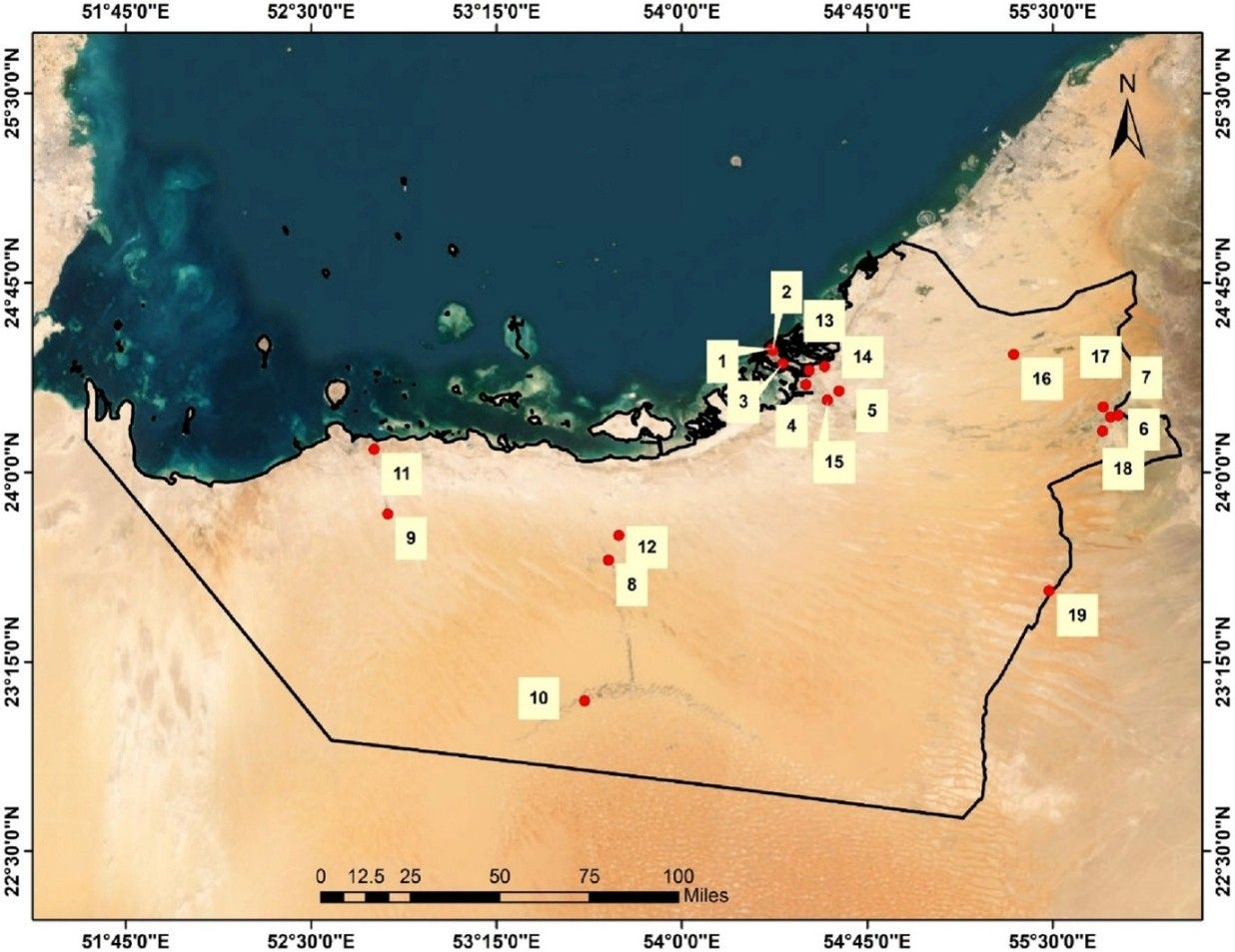
Source: https://www.frontiersin.org/journals/environmental-science/articles/10.3389/fenvs.2024.1393878/full#s3
Levels of ozone are also directly affected by this seasonal cycle, with ozone concentrations peaking in the hot, bright months between June and August. Elevated ozone levels are linked to asthma exacerbation, reduced lung function, and increased respiratory hospital admissions, which recur each summer rather than easing over time.
Ozone also seems to have resisted the region's broader air quality gains. A decade-long analysis of Dubai's air monitoring network found that between 2013 and 2021, nitrogen dioxide and sulphur dioxide fell by 54% and 93% respectively, while ozone showed no comparable improvement over the same period. Even during the pandemic, when other pollutants briefly dropped, ozone rose by an average of 8%.5
The health burden
Despite population exposure to PM in the UAE rising by over 5% between 1990 and 2021, mortality attributable to PM fell by nearly half in the same period, with the steepest declines in respiratory infections and stroke. These figures show that survival, not exposure, is what changed. Earlier diagnosis, wider access to cardiac and respiratory care, and stronger critical-care infrastructure made a PM-related event much less likely to be fatal, despite how much particulate matter people inhaled.

Improvements were not evenly spread across the healthcare system. For type 2 diabetes, mortality levels rose; a reminder that clinical gains against air-quality-linked disease are partial, not universal. While peaks in asthma, cardiovascular stress, and heat-related illness are predictable in aggregate, meaning clinics and hospitals can prepare for them, a healthcare system that absorbs more exposure each year is not on its own the long-term answer. The data also does not measure lost productivity due to illnesses resulting from heat stress, allergies, and infectious diseases on a daily basis.
Mitigation measures taken in the UAE
The UAE’s National Air Quality Agenda 20316 includes the development of an early warning system, and monitoring and forecasting air quality and resulting health impacts could lead the way for risk management through hotspot detection in different emirates. Real-time data recorded on the UAE’s Air Quality Index and National Air Quality Platform suggests that health-risk information and forecasts are available up to three days in advance.
The air quality mitigation and management steps suggested in the National Air Quality Agenda 2031 focus on reducing pollutant emissions and people’s exposure to them. The agenda proposes measures across transport, electricity generation, industry and energy, waste, construction, and natural and regional pollution. Some of the key recommendations are based on planning and permitting control, source-emissions control solutions, reducing consumption of energy and production of waste, and coordination on transboundary emissions control.
The Environment Agency – Abu Dhabi has already taken a step in this direction with an air quality modelling system designed to identify pollution hotspots, generate emirate-wide air quality maps, and produce forecasts, with a particular focus on ozone and PM, the two pollutants that the Environment Agency – Abu Dhabi flags as of greatest concern in the emirate.7
At a more tactical level, solutions such as expansion of urban green zones, incorporating outdoor air quality control measures in design specifications for infrastructure planning, modal shift for transport sector to EV vehicles, and general engineering controls on dust management across the cities major construction and logistics zones can help alleviate and mitigate air pollution’s dangers to society’s health and productivity, helping us all breathe a bit easier.
About the author: Tara Al Marzooqi is a Programme Associate in Strategy & Programmes at Frontier25
1. WHO. (2026). Air Pollution Data Portal. Retrieved from The Global Health Observatory: https://www.who.int/data/gho/data/themes/air-pollution
2. WHO. (2024). Retrieved from https://www.who.int/news-room/fact-sheets/detail/ambient-(outdoor)-air-quality-and-health
3. Abuelgasim, A., Farahat, A. Investigations on PM10, PM2.5, and Their Ratio over the Emirate of Abu Dhabi, United Arab Emirates. Earth Syst Environ 4, 763–775 (2020). https://doi.org/10.1007/s41748-020-00186-2
4. Ramadan M, Abuelgasim A, and Al Hosani N (2024, May). Advancing air quality forecasting in Abu Dhabi, UAE using time series models. Frontiers. https://www.frontiersin.org/journals/environmental-science/articles/10.3389/fenvs.2024.1393878/full#h1
5. Akasha, H., Ghaffarpasand, O., & Pope, F. (2024, January). Air pollution and economic growth in Dubai a fast-growing Middle Eastern city. Atmospheric Environment.
6. https://www.ccacoalition.org/sites/default/files/resources/files/UAE National Air Quality Agenda 2031.pdf (1).pdf
7. ADMO (2023). Environment Agency – Abu Dhabi develops bespoke air quality modelling system. Retrieved from https://www.mediaoffice.abudhabi/en/environment/environment-agency-abu-dhabi-develops-bespoke-air-quality-modelling-system/