
In 2008, an ecological crisis off the coast of the UAE exposed a glaring paradox when a number of desalination plants, the very source of the nation's water security, became an operational threat.
A dense, persistent bloom of microalgae (Cochlodinium polykrikoides) had spread across the Gulf of Oman and into the Arabian Gulf, persisting for months, decimating marine life and forcing at least five desalination plants to suspend operations as intake systems clogged. Emergency convoys of tanker trucks had to haul drinking water to east coast communities.1, 2 The episode exposed an important vulnerability that conventional infrastructure planning can overlook. A desalination plant does not need to suffer physical damage for production to stop; a major change in the quality of its source water is enough.
For countries that rely on desalination plants, protecting the sea is not simply an environmental obligation, it’s a cornerstone of water security.
Desalination has become indispensable to the modern Gulf, and the region’s cities and economies could not function without it. In 2022, the Middle East accounted for almost half of global desalination capacity (46%),3 capable of producing about 45 billion litres of water each day, or more than half a million litres every second. Saudi Arabia and the UAE alone accounted for almost two-thirds of this regional capacity.3
This is a major engineering achievement, as seawater now supplies potable water at a scale that rainfall and groundwater could never sustain in this arid region. Yet this dependence changes the meaning of water security. The fundamental policy challenge is not whether Gulf states should desalinate seawater, but how they manage the operational and environmental risks created by relying on it so heavily. An infrastructure system that depends on seawater cannot be more secure than the marine system that serves as its source.
While energy use and carbon emissions remain central to the wider environmental debate about desalination, a less recognised reality is that water production reliability depends directly on the quality of the marine environment itself.
The risks are local as well as regional
A water production strategy that accounts for source water quality must also characterise the associated risks accurately. The cumulative discharge of large volumes of brine into this shallow, largely enclosed sea has prompted concern that desalination is progressively increasing salinity across the Gulf as a whole.4, 5 Recent Gulf-wide modelling, however, does not support this concern.
The Gulf’s overturning circulation naturally exports dense, saline water as a bottom outflow through the Strait of Hormuz, while fresher, less saline water is drawn in near the surface to replace it. Even under high desalinated water production and worst-case climate change scenarios, the projected increase in average Gulf salinity by 2050 was shown to be unlikely to exceed one salinity unit (1 PSU) and was more likely to remain below half a unit (0.5 PSU).6 To put this into context, normal salinity along the UAE’s Gulf coast is 44 PSU, and varies by a similar magnitude of 0.8 PSU between summer and winter, meaning that even under worst-case scenarios any salinity increases from Gulf-wide desalination would be difficult to distinguish from natural seasonal variability.6 This finding matters because policy is not served by overstating risk.
This does not, however, show that desalination has no marine impact whatsoever, as Gulf-wide averages can conceal conditions near individual intakes and outfalls. Dense brine may remain near the seabed, local salinity and temperature anomalies may persist, and treatment chemicals may recirculate to intake waters or to adjacent ecosystems. The local consequences depend on dilution, circulation, cumulative loading, and the sensitivity of exposed ecosystems.7 The limited projected effect on average Gulf salinity therefore shifts attention to local coastal settings, where the ecological and operational consequences of seawater removal and brine discharge require site-specific assessment and management.
The direction of effect runs both ways. Desalination can put pressure on the marine environment, but marine conditions can also affect desalination performance. Harmful algal blooms can foul membranes, spike chemical treatment costs, drastically shorten filter lifespans, and force desalination plants to reduce or suspend production.8 High turbidity or oil and chemical pollutants can create similar operational bottlenecks.
While recent regional conflict has highlighted the physical exposure of desalination facilities, marine pollution released elsewhere could prove equally disruptive to water production and other seawater-dependent industries.9 Environmental protection cannot remove every risk, but degraded source water represents a vulnerability that can be avoided. Coastal water quality needs to be monitored as part of infrastructure performance, alongside conventional metrics for pumps, membranes, and distribution networks.
Following water through the city
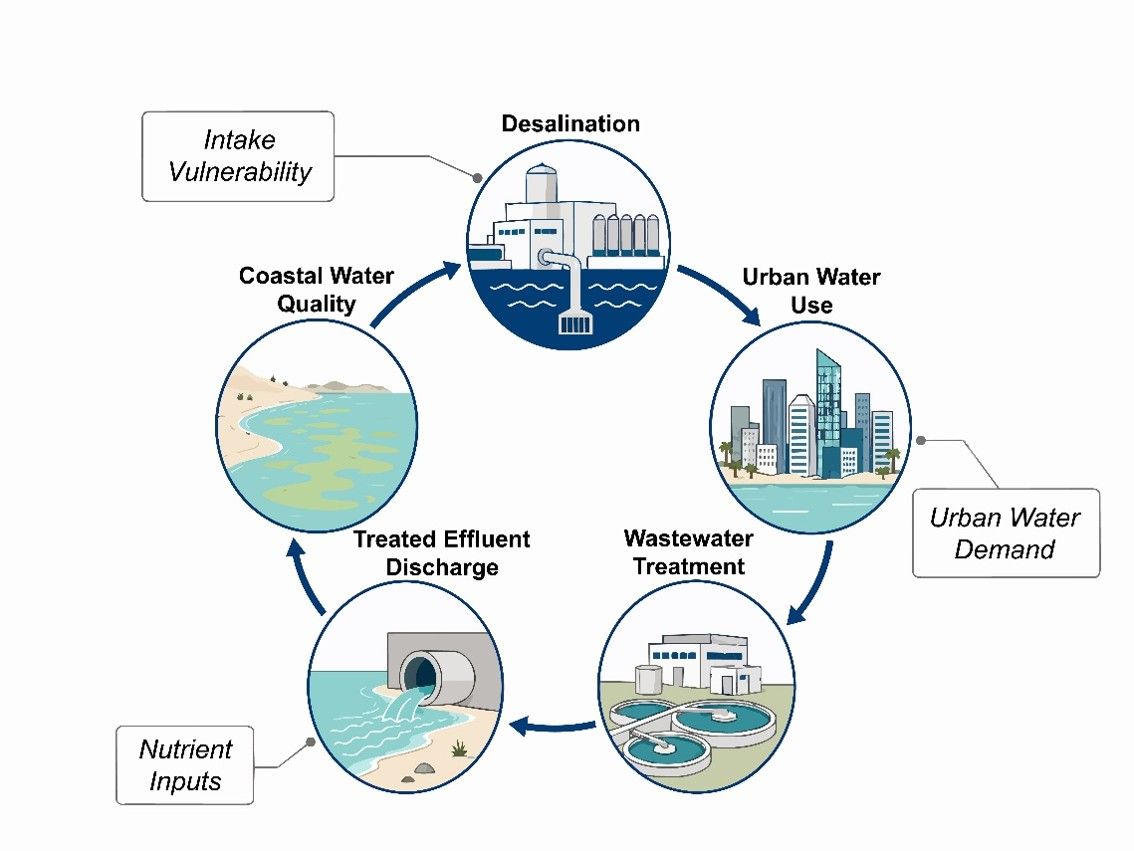
The connection becomes clearer when water is followed through a city. Seawater enters a desalination plant at the intake and becomes potable water that then passes through homes, businesses, industries, and public landscapes. The concentrated waste brine from desalination is typically returned directly to the sea, while much of the water used in the city eventually becomes municipal wastewater at a sewage treatment facility. In 2020, the eight Gulf nations generated an estimated 8.6 billion cubic metres of municipal wastewater – equivalent to more than six times the annual discharge of the Tigris-Euphrates river system – with most regional wastewater treatment plants discharging at the coast.2
The benefits of not wasting wastewater
Municipal wastewater is the primary anthropogenic source of nitrogen and phosphorus entering Gulf coastal waters, which can contribute to eutrophication, oxygen depletion, and harmful algal blooms, particularly in poorly flushed coastal areas.2 The timing and severity of specific algal blooms depend on natural factors like temperature, biology, and ocean currents, but nutrient enrichment fuels them, meaning that how a city manages its water directly affects the sea to which that water returns.
In other words, brine, wastewater, and desalination source water quality are not separate policy issues, but components of one physical cycle.
The reusing of wastewater provides a clear practical example of what integrated planning could achieve. Across the GCC, just 29% of reclaimed municipal wastewater is treated and reused.2 However, properly treated reclaimed water can replace potable water in landscaping, district cooling, construction, and industrial uses. This would reduce both the demand for costly additional desalination capacity and the volume of nutrient rich effluent being discharged into coastal waters.
The substitution would require appropriate treatment standards and storage, separate distribution networks, and reliable end users, but new desalination capacity should not be planned without first looking at how much projected demand could be avoided through leakage control, efficiency, and water reuse. Every cubic metre safely reused can reduce pressure at both the production and discharge ends of the urban water system.
Monitoring and acting on warnings
A more secure water system must also assume that no desalination plant will operate at full output under all environmental contexts, and monitoring and management are needed to ensure resilience. For example, satellites and hydrodynamic models can provide early warning of algal blooms and help forecast their movement10 (complemented by sensors and biological sampling at intakes); potable water production can be geographically distributed to avoid spatially concentrated risks; interconnected networks can allow supply to shift when one source area deteriorates; and strategic storage reserves can provide a further safeguard (Abu Dhabi’s Liwa project demonstrates that desalinated water can be stored in desert aquifers and later recovered during an emergency if carefully planned and managed11).
However, none of these measures will fully eliminate water production risks on their own. Utilities also need operating protocols that convert warnings into timely decisions about intake management, production, and transfers between networks. Together, monitoring, flexible production, and strategic reserves can prevent a local environmental event from becoming a wider water supply failure.
Building resilience across the system
An environmental assessment should follow the same system-level logic. Before construction begins on a new desalination plant, habitat mapping and hydrodynamic modelling can help compare intake and outfall locations, and ecological monitoring can test whether predicted effects are likely to remain within acceptable limits throughout a plant’s operating life.12 This assessment should include neighbouring desalination and wastewater discharges, industrial activity, or planned development within the relevant bay, lagoon, or coastal sector to account for cumulative impacts.
Existing plants also require periodic reassessment, because the coast around them does not remain fixed. A plant may remain mechanically functional while the environmental assumptions that justified its original location become outdated over time as cities expand and change around it. Over the past two decades, cities on the Gulf’s coastal zone have increased by approximately 55% in area, accompanied by reclamation and dredging, the development of artificial islands, and the expansion of ports and other coastal infrastructure.13 Reclamation, altered channels, and new outfalls can change circulation, cumulative loading, and the quality of intake water, and therefore should trigger renewed modelling and monitoring.7, 12 An environmental assessment approval should not outlive the coastal conditions it assessed.
The Gulf can lead in desalination research
Since the late 1980s, approximately 80% of desalination research on the Middle East has been produced by researchers based in the region, demonstrating a strong degree of local expertise.3 The region already possesses much of the required expertise, so the next step is to ensure that marine environmental performance becomes a routine measure of water security leadership. We now need to effectively use that knowledge to influence planning and performance.
Gulf states have strong operational experience and the scientific capacity to establish a robust international model for desalination in environmentally-demanding seas. The Gulf functions as an interconnected sea, where circulation links national waters, and algal blooms or pollution plumes can cross jurisdictional boundaries. No single country can interpret cumulative conditions from national monitoring alone. The Regional Organization for the Protection of the Marine Environment already provides an institutional basis for cooperation2 and could serve as a vehicle to advance regional coordination on these issues.
At a minimum, standardised reporting is required on plant age, technology, seawater withdrawal, discharge, and ecological setting, as well as common indicators of local salinity and temperature anomalies, chemical exposure, intake mortality, and biological condition. Compatible monitoring datasets linked to Gulf-wide circulation models would also be needed.
Every major new project should demonstrate that its proposed capacity is still necessary after efficiency and reuse have been considered, that its location is the least environmentally damaging option, that cumulative pressures have been assessed, and that ecological outcomes will be measured throughout operation.
The Gulf will continue to rely on desalination, so the choice going forward is how that dependence is managed. Seawater enters at the intake, passes through the city, and returns to the sea as brine and urban effluent. The reliability of the water supply therefore depends on decisions made across the entire system, from source water protection to wastewater reuse and coastal monitoring. In the Gulf, water security begins and ends with the sea.
References