COP31 is bringing together around 60,000 representatives from almost 200 countries under a collaborative joint presidency of Türkiye and Australia in the city of Antalya. This year’s meeting comes amidst rising global temperatures, shifting trade patterns, energy demand pressures from AI, and perhaps the most serious global energy crisis in recent history.
Against this economic and diplomatic backdrop, it’s clear that an implementation gap has emerged since the UAE’s COP28 in 2023, where a significant consensus was reached around a practical plan for transitioning away from fossil fuels in energy systems.
COP28 saw global commitments made to triple renewable energy capacity, double the rate of energy efficiency progress, and substantially reduce methane emissions by 2030. However, while progress has accelerated in many areas, it has not been enough to reduce global energy-related CO2 emissions, which still rose by 0.4% to hit 38 billion tonnes (Gt) in 2025.
The UAE Consensus at COP28 laid the groundwork for subsequent international gatherings to focus on delivery and implementation. In this respect, proposals to boost the rate of electrification and methane reduction at COP31 offer two of the most promising opportunities to address the growing implementation gap.
35 by 35: Increasing the share of electricity to 35% by 2035
Since 2019, electricity demand has been growing at more than double the pace of overall energy demand, as technological shifts involving electric vehicles, heat pumps, access to air conditioning, and industrial modernisation have gathered pace. The electricity demand of data centres has also emerged as a major challenge, putting pressure on local consumer prices and amplifying supply constraints, which have cramped the growth of the artificial intelligence sector in some countries.
Today, electricity meets about 23% of global final energy consumption, according to the International Energy Agency (IEA), leaving more than 75% of energy needs mostly dependent on fossil fuels used directly. Electrification thus provides a powerful opportunity to bring together key elements of the UAE Consensus. An electric vehicle is two-to-four-times more efficient than one powered by an internal combustion engine, and once an energy consuming activity is electric it enables the deeper potential impact of renewable electricity to accelerate decarbonisation efforts.
Electrification also supports activities providing nearly half of all GDP globally, supplying high value economic sectors such as advanced manufacturing, digital services, and artificial intelligence. This means the importance of electricity extends far beyond changing the energy mix and carbon emissions. Modern life, especially in the UAE, already depends on reliable electricity, from essential services such as air conditioning and water desalination, through to hospitals, telecommunications, and banking.
The COP31 Global Electrification Initiative aims to increase the share of electricity in global final energy consumption to 35% by 2035. It is achievable. Several major countries have already achieved or are close to the 35% level, including Korea, Japan, and China. Many smaller countries, including Norway and Bahrain, due to the structure of their economies as well as policy and technology choices, are already well beyond 35%. The UAE sits above the Middle East average of 20% with a level similar to Germany at around 23%. There are also encouraging signs of policy momentum with 25 countries announcing new electrification targets and policies since February 2026.
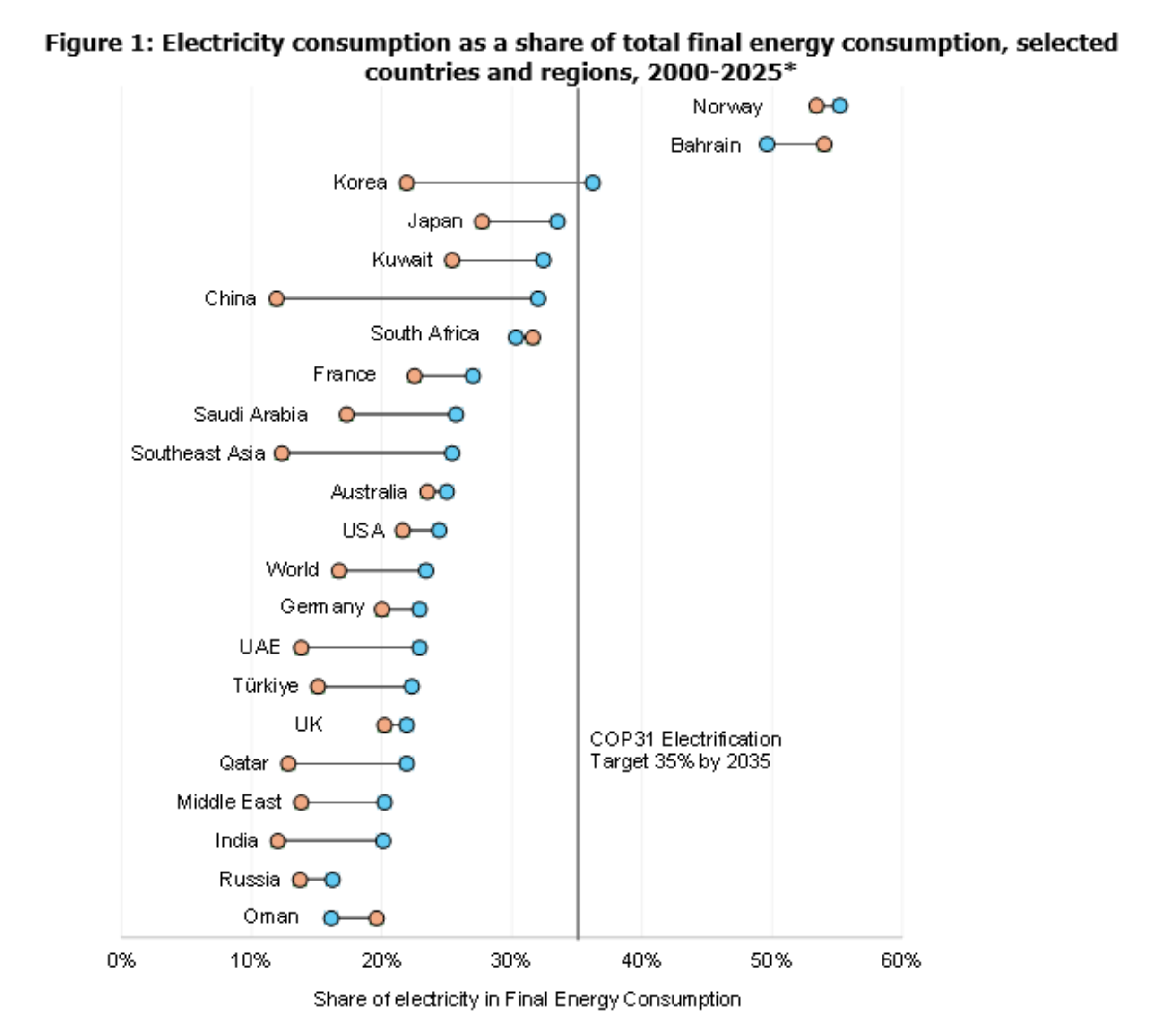
Source: Frontier25 analysis based on IEA World Energy Balances, 2026 and IEA Electrification Special Report, 2026. Note: Final energy consumption includes energy used in blast furnaces and coke ovens and excludes non-energy use. Latest data used in 2024 or 2025.
The Climate Action Tracker finds that achieving ‘35 by 35’ would require the pace of electrification to accelerate almost fourfold, whereas current policies would deliver a share of only 28% by 2035. The proposal’s significance therefore lies not simply in agreeing a target, but in translating it into policies and investment that change how energy is consumed.
The opportunities and challenges differ considerably across sectors. At the global level, buildings are already the most electrified sector, with electricity meeting nearly 40% of energy needs followed by 27% in industry. Road transport, by contrast, is currently the least developed with just 2% of its energy use from electricity. This disparity makes transport an important area of focus in pursuing the 2035 ambition, while also showing that approaches will need to be tailored by country and sector.
What does the electrification COP mean for the UAE?
If the COP31 Presidency secures agreement on the proposed ‘35 by 35’ pledge, the conference may be remembered as ‘the electrification COP’. Its lasting significance, however, will depend on translating this ambition into practical action across transport, buildings, and industry.
In the UAE, policies have already been introduced at the national and emirate-level to help drive this change. In the transport sector, electric mobility is being encouraged by the roll out of the National Electric Vehicles Policy, the Abu Dhabi EV Charging Infrastructure Regulatory Policy, and the Dubai Green Mobility Strategy. To support modal shift, Etihad Rail is developing a fully electrified high-speed passenger railway connecting Abu Dhabi to Dubai and beyond, with trains travelling at up to 350 km/h and reducing journey times to approximately 30 minutes. In another move towards electrification, Abu Dhabi aims to convert 92% of its water desalination plants from thermal desalination to reverse osmosis by 2035.
Established national policies, including the UAE's National Energy and Water Demand Management Programme and Dubai's Demand Side Management Strategy 2050 target substantial growth in the electricity sector and improvements in energy efficiency. Under such plans, Abu Dhabi is expecting to invest more than AED 300 billion (around $80 billion) in utility infrastructure in generation, transmission, and distribution to meet new power demand, with installed capacity expected to double by 2050 to 50 GW from the current 25 GW.
As part of this transition, the Abu Dhabi Future Energy Company PJSC (Masdar) in partnership with the Emirates Water and Electricity Company (EWEC) has launched the gigascale Round-the-Clock (RTC) renewable energy project with a total investment of $6.1 billion. This project under development combines 5.2 GW of solar and 19 GWh battery storage and is expected to deliver 1 GW of continuous clean power.
Such projects will be key to meeting the demand from ambitious AI infrastructure plans, such as the 5GW UAE-US AI Campus in Abu Dhabi. This new campus includes the 1 GW Stargate UAE project being developed by artificial intelligence company G42 in partnership with technology giants, OpenAI, Oracle, and Nvidia.
As other regions face constraints on the sustainable power supply needed to fuel the artificial intelligence sector, the UAE is well placed to support global efforts to accelerate both low-carbon electrification and the global demand for AI.
A slowdown in renewable energy capacity additions highlights the need for a focus on clean electrification
Global renewable capacity additions are forecast to decline 11% in 2026, ending 21 consecutive years of record-breaking annual expansion according to the IEA’s last Renewable Energy Market Report. While still the second-highest level ever registered, COP28 established the goal of tripling global renewable power capacity to more than 11,000 GW by 2030. IRENA's World Energy Transition Outlook 2026 reports that global renewable capacity reached approximately 5,200 GW in 2025, while its 1.5°C pathway requires capacity to expand to around 18,400 GW by 2035 to support the electrification of transport, buildings, and industry.
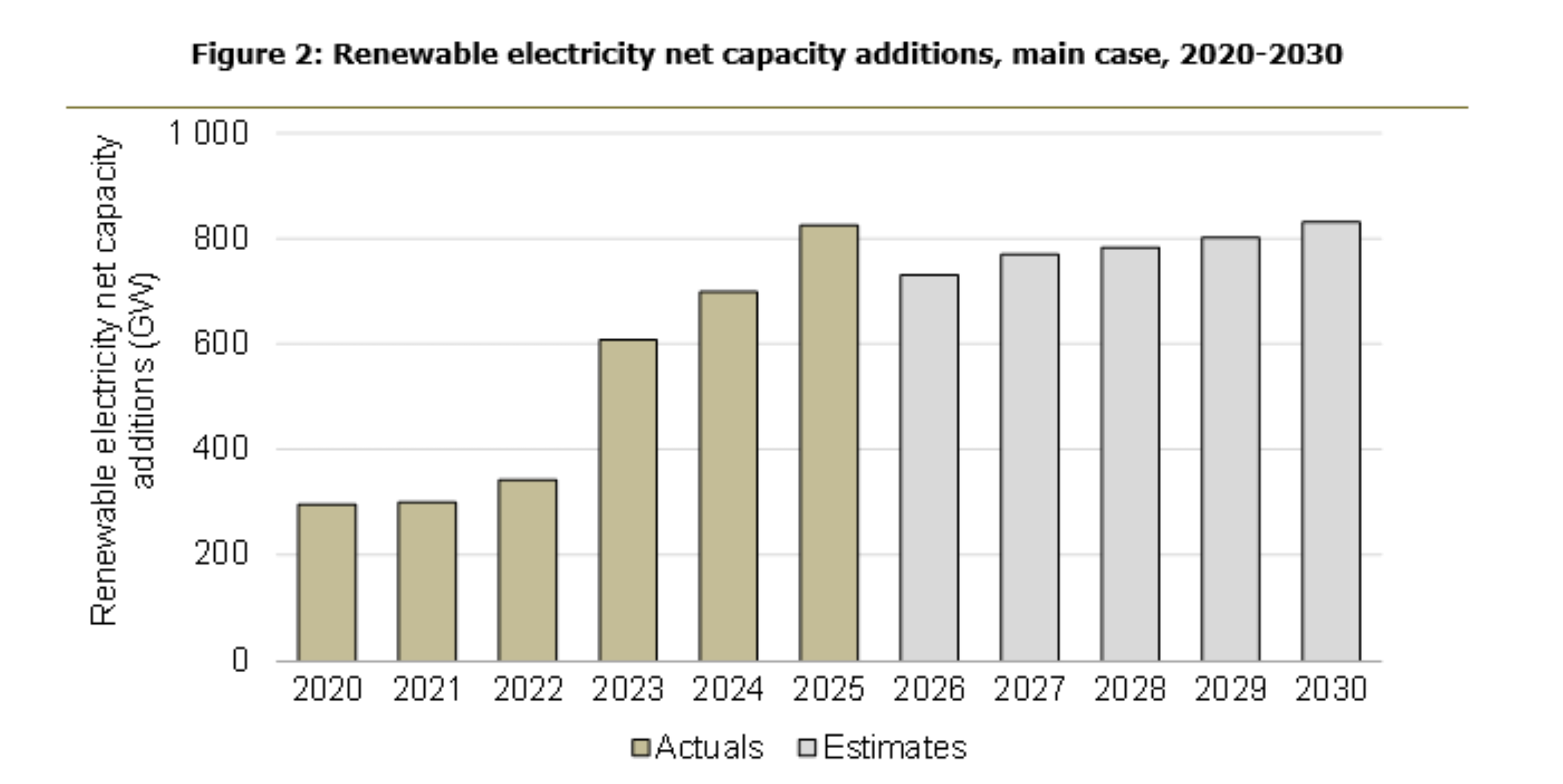
Source: IEA Renewables, 2026.
Methane reduction is perhaps the fastest way with the greatest impact to limit near term temperature rise
Methane reduction is one of the most immediate and effective opportunities to slow global warming. Responsible for approximately 30% of the increase in global temperatures since industrialisation, methane is a potent greenhouse gas with approximately 80 times the warming potential of carbon dioxide over a 20-year period.
At COP26 in Glasgow, the Global Methane Pledge established a collective ambition to reduce global methane emissions by at least 30% by 2030, compared with 2020 levels. Launched by more than 100 countries and the European Union, the pledge has since been endorsed by 159 countries, including the UAE.
COP28 in Dubai marked an important step towards implementation. Under the UAE Presidency, the Oil and Gas Decarbonization Charter brought together 50 founding companies, including major national oil companies, around commitments to achieve near-zero upstream methane emissions and eliminate routine flaring by 2030, alongside net-zero operations by 2050. The UAE Consensus also called for accelerating and substantially reducing non-CO2 emissions, including methane, globally by 2030.
The UAE has reinforced these commitments through international climate finance, including a $100 million contribution to the World Bank's Global Flaring and Methane Reduction Partnership. As its largest founding contributor, the UAE is helping support developing countries in reducing methane emissions, eliminating routine flaring and strengthening technical capabilities.
In 2024, COP29 in Baku expanded the focus to waste, where methane emissions are a major and growing source. More than 30 countries endorsed the Declaration on Reducing Methane from Organic Waste, encouraging measurable waste-methane action in national climate plans. The European Commission also launched a roadmap to strengthen cooperation between gas importers and exporters on methane measurement and reduction.
COP30 in Belém shifted attention to delivery. Governments and philanthropies announced $278 million in new methane-abatement funding, while a UK-led statement supported by 11 countries opened the way for markets to reward very low-methane oil and gas production.
At COP31 in Antalya, attention will be on the practical mechanisms needed to deliver these ambitions. The joint Presidency of Türkiye and Australia has explicitly included zero waste and methane reduction among its action priorities, and a Global Methane Pledge Ministerial will be an important moment to move the agenda forward. Work is also advancing on the marketplace proposed in the COP30 statement, which would recognise and reward oil and gas production with very low methane emissions, potentially aligning commercial incentives with environmental performance.
Frontier25 has been supporting these efforts within the UAE and wider region through its UAE Methane Policy Review, which brought together all key stakeholders from government, industry and civil society around six policy recommendations to strengthen methane action.
An Earthshot is needed for climate action
The success of COP31 will ultimately be measured not by the commitments made, but by their translation into effective policies, investment, innovation, and measurable emissions reductions. This implementation challenge is central to Frontier25's mission and the UAE's COP28 legacy.
Our rebranding as Frontier25 (formerly UICCA) in 2025 reflected two historic turning points: a new urgency to confront climate change, following the first calendar year in which global temperatures exceeded 1.5°C above pre-industrial levels, and renewed optimism that the technologies and policies needed to address the challenge are now within reach. Urgency without optimism risks giving way to despondency, while optimism without urgency risks complacency. Together, they can inspire action.
This philosophy is also at the heart of The Earthshot Prize, which convenes global innovators, investors and environmental leaders in Mumbai on 16-17 November to celebrate and scale practical solutions. Just as humanity’s Moonshot to land a person on the Moon and return home safely brought out the best of scientists, engineers, businesses, and government to achieve the goal, The Earthshot Prize looks to inspire the same resolve to protect our planet. As an official nominator supporting dozens of such solution-focused organisations from across the UAE and wider region, Frontier25 will be represented at the summit, reinforcing our commitment to identifying promising innovations and helping turn them into meaningful impact.
At COP31 Türkiye, as the focus on implementation continues, electrification and methane are two of the most important opportunities to bring forward the outcomes of the UAE Consensus. Through our work across our accelerators, alliances, and advisory pillars and storytelling and behaviour change, Frontier25 and The Climate Tribe continue to support the implementation agenda, bringing together innovation, government, industry, the community, and international partners to turn climate ambition into practical solutions.
About the authors: This paper was led by Dr Nicholas Howarth, Director of Strategy and Programmes at Frontier25, with valuable contributions from Sarmad Hussain, Nour Mezher, and Ulkar Salmanova.