
When world leaders gather for the UN Water Conference 2026 in Abu Dhabi from 8th to 10th December, it will be only the third UN water conference ever held. Aimed at accelerating progress towards Sustainable Development Goal 6 (SDG6) – safe and sustainable water and sanitation for all by 2030 – mobilising finance and delivering the infrastructure needed, especially in water scarce regions, must be a priority at the conference.
According to a UN University report published in the leadup to this year’s conference, the world is entering an era of water bankruptcy – a condition of structural imbalance between water demand and available resources. This concept draws attention to the evidence that societies depend on both renewable water flows and long-term natural storage, comparable to drawing on income and savings, similar to a water balance sheet. The concern is that extraction rates are unsustainable, far exceeding what is available, meaning innovation is also needed.
The conference’s co-hosts – the UAE and Senegal – are holding the event in one of the world’s driest capital cities, Abu Dhabi, where natural scarcity makes it impossible to ignore water as the bedrock of national security, food security, and economic prosperity. As a place where sustainability and scarcity are so deeply intertwined, Abu Dhabi is the right setting to finally unlock investments in safe drinking water supply, sanitation, and natural infrastructure.
Five criteria for turning global commitments into action
Building water awareness is no longer the challenge. The UN’s Water Action Agenda, launched in 2023, mobilised more than 830 voluntary commitments from governments, businesses, international organisations, and civil society, ranging from local projects to institutional investments and policy reforms. Success in Abu Dhabi now depends on turning these intentions into tangible results. As a group of experts in finance, innovation, policy and technology, we suggest there are five main criteria that can do this most effectively:
1. Drinking water: Secure commitments to extend safely managed drinking water to at least 350 million additional people every year through to 2030, accelerating progress towards universal access. Progress should be tracked through national targets and annual reporting.
2. Sanitation and hygiene: Secure commitments to extend safely managed sanitation to at least 570 million additional people every year by 2030, including safe toilets, wastewater collection, treatment, and reuse. Secure commitments to provide basic hygiene services to at least 280 million additional people every year by 2030.
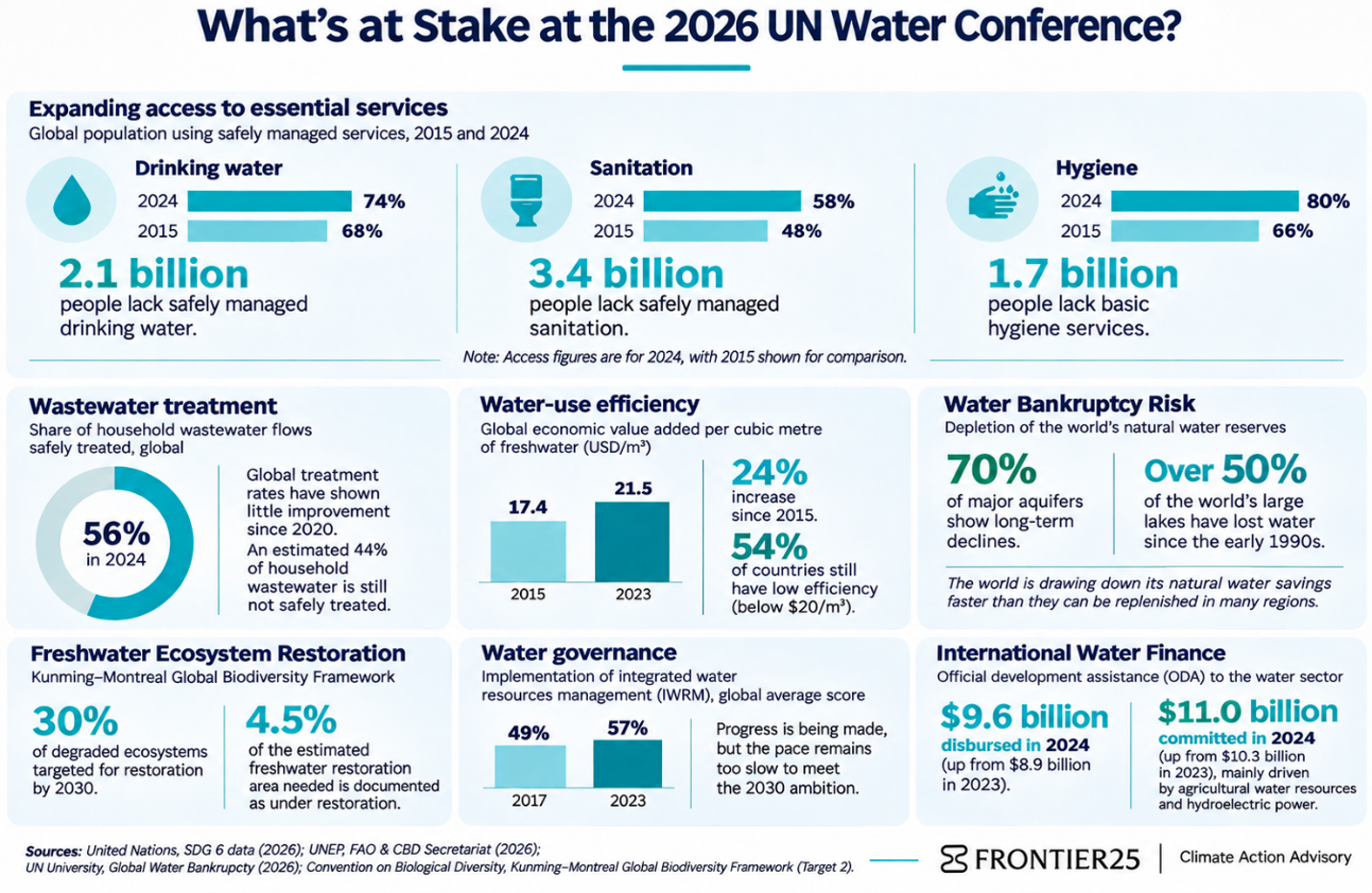
3. Natural infrastructure: It is essential that investments in nature-based solutions are included in commitments to boost water financing and innovation. A 2026 UN report found that just 4.5% of the estimated freshwater restoration area needed is documented as under restoration, while the Kunming–Montreal target is to bring 30% of degraded ecosystems under restoration by 2030.
4. A water investment initiative: An initiative can be launched to mobilise public and private capital for water projects at scale, particularly in developing economies. It could be anchored by: a project-preparation facility to build a pipeline of investment-ready projects; standardised blended-finance structures, with well-defined governance, guarantees, and first-loss capital from development finance institutions to reduce risk for private investors; common standards for blue bonds and sustainable water finance to direct capital markets towards measurable outcomes; and investment commitments announced at the conference and tracked annually against SDG6 results.
5. A water innovation accelerator: An international accelerator can be launched to bring proven and emerging technologies to commercial scale.
These five criteria for success include three measurable outcomes to accelerate universal access to water, sanitation and hygiene, and natural infrastructure, supported by two international initiatives to mobilise investment and bring innovation to scale. These draw on the perspectives and recommendations of the authors, taking into account established UN targets and what is needed to deliver them.
The annual figures above are illustrative estimates derived from the latest UN-reported access gaps in 2024 divided by the six years to 2030. According to the WHO/UNICEF Joint Monitoring Programme, achieving universal access by 2030 would require an eightfold increase in the current rate of progress on safely managed drinking water, a sixfold increase for safely managed sanitation, and a twofold increase for basic hygiene.
What’s at stake at the 2026 UN Water Conference?
These criteria cannot exist alone. Good governance underpins them all, from policies that make water resilience an explicit goal, to regulators that enable basin-level planning and investable projects. And each needs to be considered in relationship to agriculture, which accounts for 72% of freshwater withdrawals yet is widely regarded as the least efficient water user. Even modest gains in irrigation can generate significant water for other categories of need.
The need is still there, despite some progress. Between 2015 and 2024, the share of the global population with access to safely managed drinking water increased from 68% to 74%, according to United Nations analysis. That has left 2.1 billion people still lacking safely managed drinking water and 3.4 billion lacking safely managed sanitation. This means that while the world is moving towards achieving the SDG6 goals, it is not at the rate needed to do so by 2030.
Closing the global water financing gap
A major focus for the conference is being built around what is needed to deliver the financing and infrastructure needed to achieve SDG6. Just as water is essential to all aspects of the economy, finance needs to be deployed across all aspects of building a more resilient, sustainable water supply. This will require not only more capital, but better mechanisms to direct investment towards viable water projects.
The UAE’s Ministry of Foreign Affairs has highlighted the total $6.7 trillion financing gap that the World Bank says is needed to meet water infrastructure needs and deliver SDG6 by 2030. However, private capital currently only contributes less than 2% of water spending, with public sources providing the overwhelming share. While water has considerable economic value, translating that value into predicable revenues and financeable projects can be challenging. At the same time, providing safe and affordable water to the poorest people must remain a priority.
The UN Water Conference is an important opportunity to make progress on encouraging greater private sector investment to contribute to these objectives by helping establish water as an investable asset class – not only for the sake of meeting short and medium-term goals, but to unlock the capital that accelerates innovation, paving the way for dividends far into the future.
Models to achieve this include using blended finance and multilateral development bank guarantees to help de-risk emerging-market projects. The GCF-IFC Scaling Resilient Water Infrastructure Facility also offers a good example of how public-private partnerships can bring capital and operational discipline to water projects. Blue bonds can also direct capital markets towards measurable outcomes for increasing water access and sanitation. In many cases, the binding constraint is not capital, but establishing the pipeline of bankable projects underpinned by credible tariffs and standardised contracts.
Early-mover financial institutions are already translating this agenda into providing capital at scale. For example, First Abu Dhabi Bank (FAB) became the first bank in the Middle East and North Africa (MENA) region to sign the UN Sustainable Blue Economy Finance Principles and is a global early mover after setting up its AED100 billion blue finance target for 2026–2035. Its $70 million of blue bond issuances have also been a first in the region by a financial institution, helping finance around 430,000 m³ per day of wastewater treatment and 37 million litres per day of renewable-powered desalination.
Building a pipeline of bankable projects requires action at two levels: national commitments must be translated into the tariff, contract, and regulatory changes that bring water within reach of private capital, while individual projects need the preparation and technical assistance that make them bankable, with grant, development and commercial financiers working together. The Global Climate Finance Centre supports both through the Water Finance Framework developed with Water.org, compact clinics that help countries turn water plans into financeable portfolios, and stakeholder coordination such as the UAE Water Finance Leaders Forum, launched with the UAE Ministry of Foreign Affairs in run up to the conference.
Through global nonprofit organisations, private sector banks like FAB are also finding innovative ways to provide affordable water and sanitation for low-income households. For example, as of June 2026 the Water Equity programme had delivered 1.7 million microloans to mostly women to provide around 10 million extra people with safe water or sanitation.
Accelerating water innovation from pilot to commercial scale
Promising new technologies could significantly reduce the cost of water provision and wastewater treatment and improve access, yet many struggle to attract finance and achieve commercial adoption. For example, advances such as being developed within TII in Abu Dhabi in membrane technologies, AI-enabled control systems, and water pretreatment offer opportunities to improve desalination efficiency, particularly in water-scarce regions where desalination is essential to water security.
Research from NYU Abu Dhabi highlights the barriers to adopting innovative water technologies. Water infrastructure procurement often favours established solutions, where the perceived safety of proven technologies discourages experimentation or risk taking. As technological development accelerates, risk aversion in procurement and investment may increasingly become a greater barrier to reducing water costs than technological limitations themselves.
Innovation accelerators can help bridge the gap between research, demonstration, and commercial deployment. By connecting innovators with utilities, industrial customers, investors, and regulators, they can facilitate real-world testing, independent technology validation, early-stage finance, and access to potential buyers. For water startups, scaling innovation requires more than a successful pilot. Access to real-world testing environments, industry partners, investment, and clear pathways to commercial contracts is essential. International examples of water focused accelerators include Imagine H2O and the Water Council’s BREW Accelerator in the US.
Through initiatives such as Hub71, Abu Dhabi’s global technology ecosystem, and Frontier25's sustainability focused Launchpads Programme the UAE offers a global platform that can connect innovators with customers, regulators, and international markets. One example is Archireef, which develops innovative coral reef restoration solutions. Similarly, through its Circular Economy Launchpad, Frontier25 supports companies such as Desolenator in advancing innovative water solutions towards commercial deployment. These examples show how local deployment and institutional collaboration can pave the way for wider commercial adoption and international expansion.
In the water-food nexus, the UAE FoodTech Challenge, organised by the International Affairs Office at the UAE Presidential Court and Tamkeen, has backed water-smart innovations with over $2 million in cash grants, helping bridge the gap from early-stage innovation to scalable commercial success. Examples include HyveGeo, a UAE-founded startup whose biochar improves water retention in desert soils, and Permia Sensing, a UK-founded startup that uses AI, bioacoustic sensors, and drones to detect tree stress and water issues early – both of which are now scaling with industry partner Silal, one of the UAE and region’s leading agri-tech companies. Overall, past awardees have raised over $48 million in follow-on funding and launched more than 50 pilot projects, showing the important role ecosystem support platforms can play.
This year’s UN Water Conference presents an opportunity to build on these models through an international water innovation accelerator, accelerating the deployment of solutions across desalination, wastewater treatment and reuse, water efficiency, and decentralised supply.
Making desalination more sustainable and efficient
Desalination is becoming increasingly important for water security, particularly in water-scarce regions. According to the International Energy Agency, the Middle East and North Africa produced 12 billion cubic metres of desalinated water in 2024, with production projected to triple by 2035. The transition from energy-intensive thermal desalination to electricity-powered reverse osmosis has already delivered substantial efficiency improvements. Today, reverse osmosis and other membrane technologies account for more than 60% of the region's installed desalination capacity.
However, today we are seeing slower gains in the innovation space for this technology. Fresh thinking is needed in the areas of integrating renewable energy, developing longer-lasting membranes and sustainable alternatives to treatment chemicals, improving efficiency through advanced controls and AI, and minimising concentrated brine waste.
These capabilities are already being advanced locally, through institutions like NYU Abu Dhabi’s Water Research Center. Using its unique reverse osmosis membrane manufacturing capability it has produced the UAE’s first locally-made membrane module, which can be tailored to the Gulf’s waters, offering the potential for reduced fouling and increased energy efficiency. It has also patented reverse osmosis membranes with built-in spacers, increasing the surface area of membranes by up to 30% and reducing energy consumption by 25%, as well as ultrafiltration membranes for agriculture using recycled plastic bottles. Through greater university-industry engagement and long-term research funding, innovations like these can transform the future of desalination.
Strengthening water access and resilience through decentralised solutions at the point of greatest need
Telecommunications leapfrogged fixed-line infrastructure through mobile networks, while energy systems are becoming increasingly electrified and decentralised. Water infrastructure now has an opportunity for a similar transformation. Large desalination plants and pipelines will remain the backbone of supply in many regions, but they cannot always reach remote communities economically or provide sufficient resilience when centralised networks are disrupted. Smaller, modular, and decentralised technologies could complement these systems by producing water closer to where it is needed.
Desalination meets around half the UAE's water demand, with four plants providing approximately 60% of that capacity. While efficient, such concentration also highlights the importance of diversifying water production capacity to strengthen long-term resilience and ensure continuity of supply. Large desalination plants will remain the backbone of national water systems, but smaller, decentralised facilities in the range of 1,000 to 10,000 m³/day can complement them, providing flexible and resilient supplies closer to where water is needed.
A growing range of technologies is making decentralised water production more practical and affordable. Desolenator, a company supported through Frontier25's Circular Economy Launchpad, uses industrial waste heat to produce water without conventional membranes, with projects in Dubai and Al Ain, including a partnership with Silal to produce drinking and irrigation water from seawater and groundwater. Baynunah's Ma Hawa technology takes a different approach, producing drinking water directly from atmospheric moisture.
Decentralised water systems can also incorporate wastewater recycling, rainwater harvesting, and digital monitoring, enabling water to be reused for irrigation, cooling, and other applications. No single technology offers a complete solution, but combining complementary approaches can significantly strengthen water security and resilience.
Policymakers can accelerate this transition by supporting first-of-a-kind projects, encouraging the productive use of industrial and datacentre waste heat for water and rewarding resilience alongside cost in infrastructure procurement. The UN Water Conference offers an opportunity to advance these approaches and demonstrate how decentralised solutions can complement national water systems.
UN Water Conference 2026: A moment for consensus and action
This year’s UN Water Conference comes at the culmination of an extraordinary season of international environmental diplomacy: the Biodiversity COP17 in Armenia, COP31 in Türkiye, and now the UN Water Conference in Abu Dhabi. Water is the common thread connecting these gatherings, lying at the heart of climate adaptation, sustaining biodiversity and healthy ecosystems, and underpinning economic and social development worldwide.
The UAE has already demonstrated through its successful convening of COP28 in Dubai that international consensus can be translated into ambitious global commitments. The UN Water Conference offers an opportunity to build on that legacy, bringing governments, financial institutions, businesses, and innovators together around practical solutions to accelerate progress towards SDG6.
Success will require progress across all five proposed criteria, supported by greater water-use efficiency, wastewater treatment and reuse, the protection of freshwater ecosystems, and stronger international cooperation. This includes more integrated national energy, water, and climate plans, while strengthening transboundary cooperation, where operational arrangements for shared water resources remain weak.
The ultimate measure of success in Abu Dhabi will not be the commitments announced, but the investments mobilised, innovations deployed, and improvements in water security delivered.
Contributors and acknowledgements
This article was led and coordinated by Dr Nicholas Howarth, Director of Strategy and Programmes at Frontier25, Kevin Czok, Accelerator Programme Senior Manager at Frontier25, and Zayed Shah, Accelerator Programme Project Leader at Frontier25.
Valuable contributions were also provided by the following experts from leading research institutions, financial organisations, innovation platforms and water technology companies.
Dr Philip Hart, Chief Researcher, RSERC, Technology Innovation Institute (TII)
Dr Shargiil Bashir, Executive Vice President and Chief Sustainability Officer, First Abu Dhabi Bank (FAB)
Eman Saeed, CFA, Growth and Strategy Lead, Hub71
Mina Guli, CEO, and Tiffany Kary, Director of Research, Media and Communications, Thirst Foundation
Sandra Lozo, Director - Climate & Water Finance, GCFC
Alexei Levene, Co-founder and Chief Growth Officer, and Alp Katalan, MENA Commercial Lead, Desolenator
Michael Rutman, CEO, Baynunah Watergeneration Technologies (Ma Hawa).
Program Team, Ideas Abu Dhabi
Professor Douglas Crawford-Brown, Professor Emeritus, Universities of Cambridge and North Carolina; Frontier25 Advisory Council Member and Non-Resident Fellow